 EN
EN IT
IT

Endorecept Blood: the first non-invasive test to assess endometrial receptivity
Dear Valued Customer,
Genomica is pleased to introduce ENDORECEPT Blood, the first non-invasive test for assessing endometrial receptivity. It is designed to determine, with high precision, the optimal day of the endometrial cycle to perform embryo transfer, by identifying the correct window of implantation through a simple blood draw.
A significant number of women undergoing assisted reproduction technologies (ART) do not achieve pregnancy despite the transfer of high-quality embryos. In many cases, implantation failure may be due to a lack of synchronization between the embryo and the endometrium, particularly when the embryo is transferred into a uterus that is not yet receptive. The window of implantation is a specific time interval during which the endometrium reaches a receptive state that supports embryo adhesion and implantation. For most women, the window of implantation occurs within a predictable timeframe; however, in a substantial proportion of patients it may be advanced or delayed compared with expected timing. In such circumstances, embryo transfer may take place when the endometrium is non-receptive, leading to implantation failure. This asynchrony between an implantation-ready embryo and the endometrial receptivity window is considered one of the most frequent causes of recurrent implantation failure (RIF). For these patients, accurately identifying the individual window of endometrial receptivity is therefore essential in order to plan a personalized embryo transfer (pET).
ENDORECEPT Blood is based on the analysis, in plasma, of specific biomarkers consisting of circulating microRNAs (miRNAs) involved in biological processes associated with endometrial receptivity. miRNAs are small non-coding RNA molecules that modulate the expression of proteins involved in key mechanisms of endometrial preparation for implantation, including cell adhesion and local immune modulation. The test defines the expression profile of approximately 300 miRNA biomarkers, capable of regulating more than 1,000 genes related to endometrial receptivity, using high-resolution NGS sequencing. An advanced bioinformatics workflow, supported by a dedicated computational predictor, processes the miRNA expression profile and classifies samples according to endometrial receptivity status. This approach enables the identification of a patient-specific, personalized window of implantation and supports pET planning during the period of maximum endometrial receptivity, thereby increasing implantation probability and improving overall clinical outcomes.
✔ Non-invasive – requires only a simple blood draw, avoiding endometrial biopsy
✔ Accurate – a reliable tool to support embryo transfer planning
✔ Personalized – enables planning of a personalized Embryo Transfer (pET)
✔ Comprehensive – analysis of >300 miRNA biomarkers with a key role in endometrial receptivity
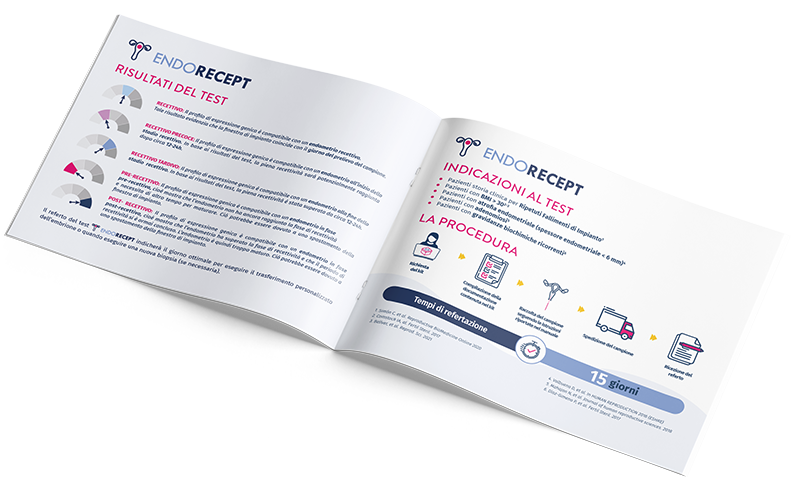
Download informative brochure of ENDORECEPT Blood
Clicking on the image above
For further information about ENDORECEPT Blood, please visit www.endorecept.it or contact our team of geneticists for support. Our Scientific & Commercial Representative is available to discuss the operational workflow and to explore the best collaboration opportunities with Genomica in order to introduce this test into clinical practice. If you would like to receive a collaboration proposal or be connected with our local Scientific & Commercial Representative, please write to us:
Contact Genomica
We look forward to sharing the most advanced and innovative diagnostic solutions in the field of genetics.
GENOMICA srl
Marketing & Communication Department
Genomica is pleased to introduce ENDORECEPT Blood, the first non-invasive test for assessing endometrial receptivity. It is designed to determine, with high precision, the optimal day of the endometrial cycle to perform embryo transfer, by identifying the correct window of implantation through a simple blood draw.
Why the window of implantation matters
A significant number of women undergoing assisted reproduction technologies (ART) do not achieve pregnancy despite the transfer of high-quality embryos. In many cases, implantation failure may be due to a lack of synchronization between the embryo and the endometrium, particularly when the embryo is transferred into a uterus that is not yet receptive. The window of implantation is a specific time interval during which the endometrium reaches a receptive state that supports embryo adhesion and implantation. For most women, the window of implantation occurs within a predictable timeframe; however, in a substantial proportion of patients it may be advanced or delayed compared with expected timing. In such circumstances, embryo transfer may take place when the endometrium is non-receptive, leading to implantation failure. This asynchrony between an implantation-ready embryo and the endometrial receptivity window is considered one of the most frequent causes of recurrent implantation failure (RIF). For these patients, accurately identifying the individual window of endometrial receptivity is therefore essential in order to plan a personalized embryo transfer (pET).
How EndoRecept Blood works
ENDORECEPT Blood is based on the analysis, in plasma, of specific biomarkers consisting of circulating microRNAs (miRNAs) involved in biological processes associated with endometrial receptivity. miRNAs are small non-coding RNA molecules that modulate the expression of proteins involved in key mechanisms of endometrial preparation for implantation, including cell adhesion and local immune modulation. The test defines the expression profile of approximately 300 miRNA biomarkers, capable of regulating more than 1,000 genes related to endometrial receptivity, using high-resolution NGS sequencing. An advanced bioinformatics workflow, supported by a dedicated computational predictor, processes the miRNA expression profile and classifies samples according to endometrial receptivity status. This approach enables the identification of a patient-specific, personalized window of implantation and supports pET planning during the period of maximum endometrial receptivity, thereby increasing implantation probability and improving overall clinical outcomes.
Key benefits of EndoRecept Blood
✔ Non-invasive – requires only a simple blood draw, avoiding endometrial biopsy
✔ Accurate – a reliable tool to support embryo transfer planning
✔ Personalized – enables planning of a personalized Embryo Transfer (pET)
✔ Comprehensive – analysis of >300 miRNA biomarkers with a key role in endometrial receptivity
Download informative brochure of ENDORECEPT Blood
Clicking on the image above
For further information about ENDORECEPT Blood, please visit www.endorecept.it or contact our team of geneticists for support. Our Scientific & Commercial Representative is available to discuss the operational workflow and to explore the best collaboration opportunities with Genomica in order to introduce this test into clinical practice. If you would like to receive a collaboration proposal or be connected with our local Scientific & Commercial Representative, please write to us:
Contact Genomica
We look forward to sharing the most advanced and innovative diagnostic solutions in the field of genetics.
GENOMICA srl
Marketing & Communication Department