 EN
EN IT
IT

POCADVANCE cfDNA GENETICS: A non-invasive cfDNA test for the genetic workup of recurrent pregnancy loss
Dear Customer,
Genomica is pleased to announce the launch of POCADVANCE cfDNA GENETICS, a non-invasive genetic test that analyzes cell-free fetal DNA (cfDNA) from maternal blood, with the aim of investigating possible genetic determinants associated with recurrent spontaneous pregnancy loss not attributable to chromosomal abnormalities.
Spontaneous miscarriage is the most common complication in early pregnancy, with an estimated incidence of 15–25% of clinically recognized pregnancies. In the vast majority of cases, the event is attributable to chromosomal abnormalities of the products of conception (POC) — and in these contexts, cytogenetic or cytogenomic analysis of the POC often provides a clinically conclusive answer.
But what happens when that answer does not come?
Approximately 40% of miscarriage events remain without an identified cause. Yet, in many cases, a cause does exist: pathogenic variants in genes involved in embryo implantation, placental formation and function, maternal–fetal immune tolerance, and early embryonic development may represent genetic determinants predisposing to recurrent pregnancy loss that are not captured by conventional investigations.
POCADVANCE cfDNA GENETICS is a non-invasive genetic test that analyzes circulating cell-free fetal DNA (cfDNA) from a simple maternal blood draw, with the aim of investigating genetic determinants associated with recurrent spontaneous pregnancy loss not attributable to chromosomal abnormalities.
The test can be performed in singleton or twin pregnancies — monozygotic or dizygotic — with ≥ 5 weeks’ gestation.
FOCUS
📍 Targeted analysis of 19 genes for which pathogenic variants have been associated in the literature with non-chromosomal recurrent pregnancy loss.
📍 Recommended as a first-level option when the clinical picture suggests a focused workup.
EXOME
📍 Clinical Exome Sequencing, with sequencing of the exonic regions of approximately 7,000 genes, including those associated with miscarriage and related phenotypes.
📍 Recommended for complex cases or when a broader analysis may add clinical value.
Identification of a pathogenic variant in one of the analyzed genes may indicate a possible genetic determinant of recurrent pregnancy loss and support more informed reproductive planning and couple counseling.
The test is particularly indicated in the following clinical settings:
📍 Ongoing miscarriage — anembryonic gestational sac, absence of cardiac activity, miscarriage in progress — when a timely, non-invasive investigation is desired;
📍 History of recurrent pregnancy loss with no identified chromosomal cause;
📍 Repeated pregnancy losses in the absence of an exhaustive clinical explanation.
Timing of blood draw
The blood sample should be collected as soon as possible after ultrasound confirmation of pregnancy loss and before any uterine evacuation procedure; alternatively, within 24 hours of expulsion of the products of conception.
For cases in which maternal blood sampling is not feasible or not indicated, the test is also available in a tissue-based version: POCADVANCE TISSUE GENETICS.

Download the Brochure POCADVANCE cfDNA GENETICS
Click on the image above
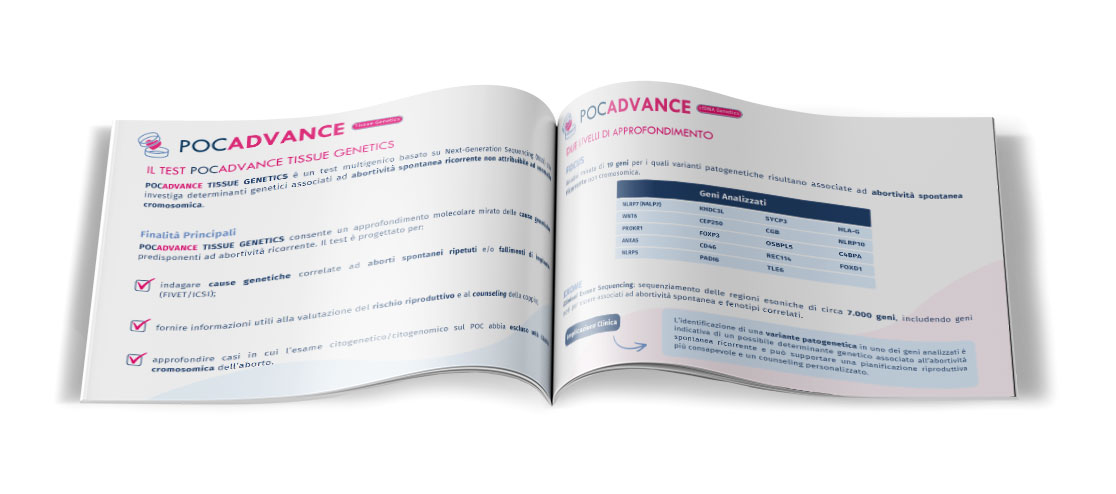
Download the Brochure POCADVANCE TISSUE GENETICS
Click on the image above
For more information about POCADVANCE cfDNA GENETICS, please visit the dedicated website or contact our team of geneticists.
Our Scientific & Commercial Representative is available for an in-depth meeting and to jointly assess how to integrate the test into your clinical practice.
If you would like to receive a collaboration proposal or be connected with our Scientific & Commercial Representative, please write to us:
Contact Genomica
We look forward to sharing the most advanced and innovative diagnostic solutions in the field of genetics.
Kind regards,
GENOMICA srl
Marketing and Communication Department
Genomica is pleased to announce the launch of POCADVANCE cfDNA GENETICS, a non-invasive genetic test that analyzes cell-free fetal DNA (cfDNA) from maternal blood, with the aim of investigating possible genetic determinants associated with recurrent spontaneous pregnancy loss not attributable to chromosomal abnormalities.
Clinical Background
Spontaneous miscarriage is the most common complication in early pregnancy, with an estimated incidence of 15–25% of clinically recognized pregnancies. In the vast majority of cases, the event is attributable to chromosomal abnormalities of the products of conception (POC) — and in these contexts, cytogenetic or cytogenomic analysis of the POC often provides a clinically conclusive answer.
But what happens when that answer does not come?
Approximately 40% of miscarriage events remain without an identified cause. Yet, in many cases, a cause does exist: pathogenic variants in genes involved in embryo implantation, placental formation and function, maternal–fetal immune tolerance, and early embryonic development may represent genetic determinants predisposing to recurrent pregnancy loss that are not captured by conventional investigations.
POCADVANCE cfDNA GENETICS: Non-Invasive Genetic Workup
POCADVANCE cfDNA GENETICS is a non-invasive genetic test that analyzes circulating cell-free fetal DNA (cfDNA) from a simple maternal blood draw, with the aim of investigating genetic determinants associated with recurrent spontaneous pregnancy loss not attributable to chromosomal abnormalities.
The test can be performed in singleton or twin pregnancies — monozygotic or dizygotic — with ≥ 5 weeks’ gestation.
Two Levels of Investigation
FOCUS
📍 Targeted analysis of 19 genes for which pathogenic variants have been associated in the literature with non-chromosomal recurrent pregnancy loss.
📍 Recommended as a first-level option when the clinical picture suggests a focused workup.
EXOME
📍 Clinical Exome Sequencing, with sequencing of the exonic regions of approximately 7,000 genes, including those associated with miscarriage and related phenotypes.
📍 Recommended for complex cases or when a broader analysis may add clinical value.
Identification of a pathogenic variant in one of the analyzed genes may indicate a possible genetic determinant of recurrent pregnancy loss and support more informed reproductive planning and couple counseling.
When to Consider POCADVANCE cfDNA GENETICS?
The test is particularly indicated in the following clinical settings:
📍 Ongoing miscarriage — anembryonic gestational sac, absence of cardiac activity, miscarriage in progress — when a timely, non-invasive investigation is desired;
📍 History of recurrent pregnancy loss with no identified chromosomal cause;
📍 Repeated pregnancy losses in the absence of an exhaustive clinical explanation.
Timing of blood draw
The blood sample should be collected as soon as possible after ultrasound confirmation of pregnancy loss and before any uterine evacuation procedure; alternatively, within 24 hours of expulsion of the products of conception.
Also Available on Miscarriage Tissue
For cases in which maternal blood sampling is not feasible or not indicated, the test is also available in a tissue-based version: POCADVANCE TISSUE GENETICS.
Learn More and Collaborate with Us
Download the Brochure POCADVANCE cfDNA GENETICS
Click on the image above
Download the Brochure POCADVANCE TISSUE GENETICS
Click on the image above
For more information about POCADVANCE cfDNA GENETICS, please visit the dedicated website or contact our team of geneticists.
Our Scientific & Commercial Representative is available for an in-depth meeting and to jointly assess how to integrate the test into your clinical practice.
If you would like to receive a collaboration proposal or be connected with our Scientific & Commercial Representative, please write to us:
Contact Genomica
We look forward to sharing the most advanced and innovative diagnostic solutions in the field of genetics.
Kind regards,
GENOMICA srl
Marketing and Communication Department